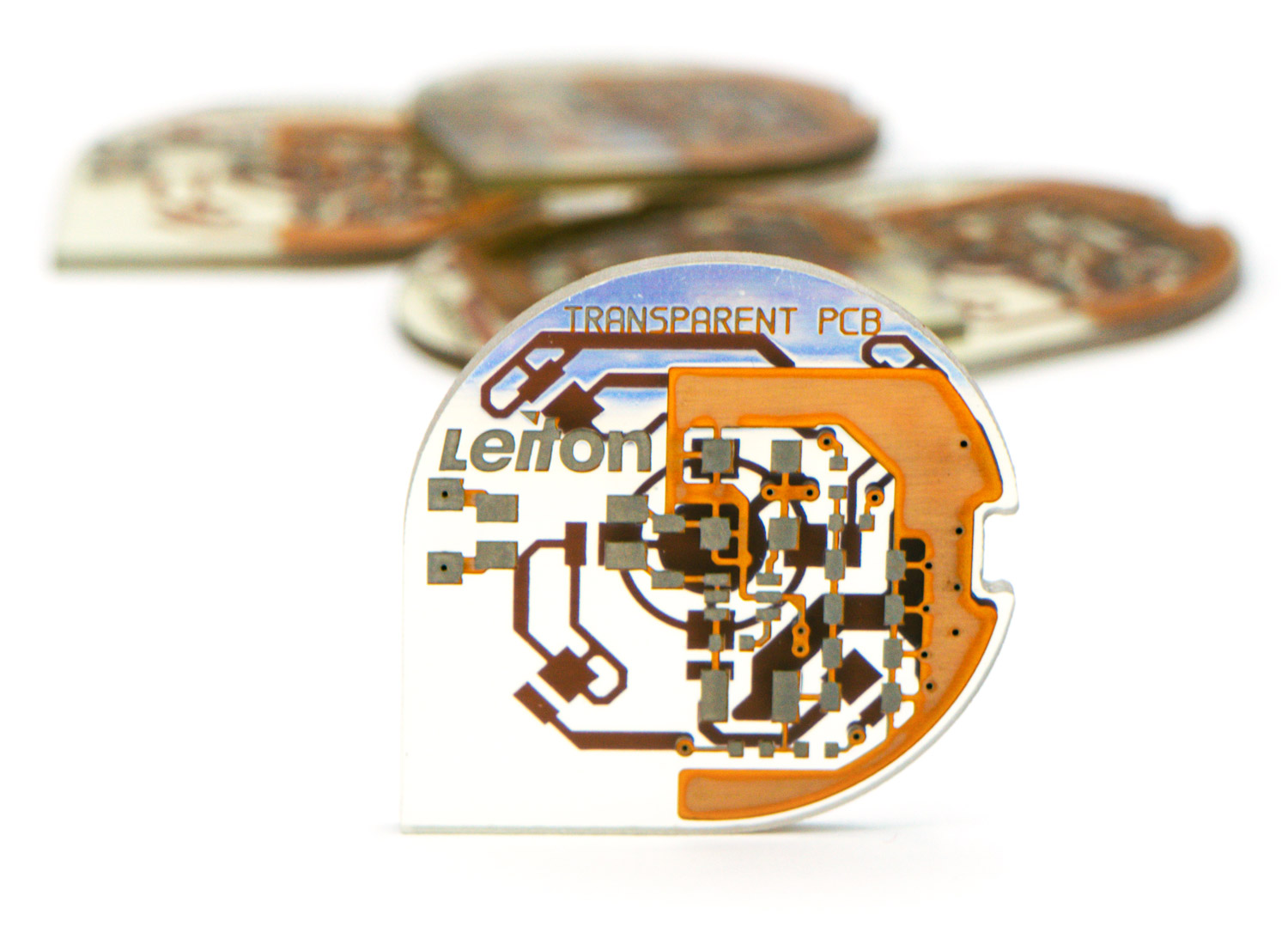
Translucent instead of opaque. A genuine multilayer, up to six layers, with a visible conductor pattern inside.
Transparent PCB | translucent material | clear multilayer up to 6 layers
Transparent PCB, translucent multilayer based on the HT820 material
Leiton's transparent printed circuit board uses a translucent base material instead of the usual opaque FR4. The material transmits light and leaves the conductor pattern visible. It is manufactured up to a 6-layer multilayer.
This is what sets it apart from the market: transparent circuits there are mostly single or double layer, or based on glass substrates. A plated-through multilayer made from translucent laminate allows more complex routing and multilayer interconnection without giving up the optical character.
Transparent PCB
A clear note belongs here. The material is translucent, not optically clear. Light transmittance is around 55 percent with diffuse scattering. For even, area-wide light distribution this is an advantage. It is not designed for maximum optical clarity.
Applications
Lighting and LED:
LED modules, backlit panels and light surfaces with even light distribution
Signage and display:
transparent carriers for lettering, indicators and display backplanes
Architecture and interior:
decorative and architectural lighting, light elements in glass and surface design
Retail and exhibition:
exhibits, showpieces and point-of-sale installations with visible electronics
Design and prototyping:
design objects and samples where the visible conductor pattern is a feature
far more routing than typical single-layer transparent solutions.
Light-transmitting:
light transmittance from 55 percent with diffuse scattering. Even, area-wide light instead of point see-through.
Visible conductor pattern:
the exposed circuit becomes a design feature of the product.
Low-halogen:
chlorine <900 + bromine <900, together <1500 ppm (parts per million).
Established processes:
standard imaging, drilling, plating, etching and typical surface finishes such as ENIG or lead-free HAL.
Important notes:
The material is translucent, not crystal clear. The flame rating is UL94 HB and therefore not flame retardant to V-0 or V-1. Suitability must be assessed against the fire protection requirements of the specific application.
The material is low-halogen, not halogen-free. The combined content of chlorine and bromine is below 1,500 ppm (parts per million).
The maximum continuous operating temperature is 75°C. Under direct UV exposure, the epoxy-based material yellows over time. For outdoor use, shaded and ventilated installations are therefore suitable; direct sunlight is critical.
Conformity certificates such as RoHS and REACH are available on request.
Request transparent PCB
What we need for a reliable enquiry: number of layers, dimensions and light requirements. Ideally also layout data (ODB++, Extended Gerber, KiCAD or similar), desired final finish, as well as quantity and delivery deadlines. We assess feasibility from the layout, including the light effect of the planned routing.
Why Leiton: technical consultation from the light effect of the layout to the final finish, CAM inspection (CAM, Computer Aided Manufacturing, preparation and verification of production data), prototypes through to series production and personal availability. Leiton allocates projects appropriately according to price, delivery time and technology.
A transparent circuit board is the right choice when light needs to pass through the board or when the visible routing is part of the product design. Typical cases include backlit panels, signage, light surfaces and exhibits with exposed electronics. If light is only emitted forwards and the circuit board remains concealed, standard FR4 with white solder mask or an aluminium core circuit board is sufficient. Both are cheaper and available with flame retardancy to UL94 V-0 (flammability classification by Underwriters Laboratories).
Glass substrates are crystal clear but brittle, usually one or two layers, and require special processes. Film circuits on PET (polyethylene terephthalate) with ITO (indium tin oxide) are thin and partly flexible, but severely limited in current-carrying capacity and solderability. Leiton's transparent circuit board is a through-hole multilayer made from translucent laminate with up to six layers and runs through established circuit board processes including SMT assembly (Surface Mount Technology). Where optical clarity is more important than routing density, glass remains the better choice. Where multilayer routing with a visible circuit is required, the translucent multilayer is the appropriate solution.
Copper is opaque. Conductor tracks and copper areas appear as shadows when backlit. The routing is therefore deliberately planned in the layout — either as a visible design feature or with reduced copper areas in the light-active zones.
Yes. The solder heat resistance is 288°C over three cycles, and final finishes such as ENIG (Electroless Nickel Immersion Gold) are available. The glass transition temperature (Tg) starts at 105°C. The maximum continuous operating temperature is 75°C. Suitability for applications with permanently high operating temperatures must be assessed on a case-by-case basis.
UL94 HB is not flame retardant to V-0 or V-1. Whether this is sufficient is determined by the fire protection requirements of the application, not the material. For decorative lighting, trade fair construction and exhibits, HB is frequently sufficient. For devices with normative fire protection requirements, suitability must be demonstrated at assembly or device level.
No, it is low-halogen. The combined content of chlorine and bromine is below 1,500 ppm (parts per million). Low-halogen is not the same as halogen-free. RoHS (Restriction of Hazardous Substances) and REACH (Registration, Evaluation, Authorisation and Restriction of Chemicals) are separate topics and are verified independently.
With limitations. The maximum continuous operating temperature is 75°C. In shaded and ventilated installations, this is not critical outdoors. With direct sunlight, surface temperatures can quickly reach 60°C to 80°C depending on absorption and structure — in enclosed housings and behind glass even higher. Combined with the self-heating of LEDs (Light Emitting Diodes), this limit may then be exceeded. Such installations require thermal design measures, such as shading, ventilation or reduced power density, and temperature measurement on the actual assembly. For yellowing under UV light (ultraviolet), see the following question.
Under UV exposure, yes. The base material is an epoxy-based laminate, and epoxy resins yellow under UV through photo-oxidation. With direct sun exposure and no UV protection, visible yellowing can be expected within months. For outdoor applications with visual requirements, a UV-filtering cover should therefore be provided. Prolonged operation close to the temperature limit of 75°C can also cause the material to darken over its lifetime, independently of UV. In indoor applications with moderate operating temperatures, yellowing is generally not a concern, as white LED light contains virtually no UV component.
On the number of layers, format and panel utilisation, on the special material HT820 compared to standard FR4, as well as on the final finish, quantity and delivery time. Prototypes and small series bear the material costs more heavily; unit price decreases with series production. Reliable pricing results from the layout, not from blanket figures.
Common terms include translucent circuit board, light-permeable circuit board, transparent PCB (Printed Circuit Board) and clear PCB in English. Not included are glass PCBs on glass substrates and film circuits on PET (polyethylene terephthalate) or ITO (indium tin oxide). These are different technologies.
Member of the Fachverband Elektronik-Design
Expertise through active exchange
Expertise through training and further education
ISO tested by the most renowned auditor in Germany
ISO 9001:2015 Quality Management
ISO 14001:2015 Environmental Management
UL approvals for various types of circuit boards
UL for rigid FR4 PCBs
UL for flexible circuit boards
UL for aluminum IMS boards
Attention! The following options have been adjusted for production reasons and are highlighted in color:
Contact us
We can consult you by phone, email or in person on site.