

Coverlay | cover film | rigid PCB | FR4 | instead of solder mask | PCB manufacturing
Coverlay instead of solder mask on rigid FR4 PCBs
Coverlay on FR4: film instead of solder mask
For some applications, a coverlay replaces the solder mask. The film consists of polyimide with an adhesive layer and is laminated onto the finished outer layer under pressure and temperature. Leiton uses a coverlay with 25 µm polyimide and 25 µm adhesive. This technique is standard for flexible circuits. On request, Leiton also applies it successfully to rigid PCBs.
The reason is both normative and mechanical. The design standard IPC-2221 (IPC, standards body of the PCB industry) permits reduced conductor spacing under a permanent polymer coating (Table 6-1, category B4). Solder mask formally qualifies. In practice, however, solder mask is often not accepted as insulation, because coating thickness on conductor edges and freedom from pinholes are not specified. A laminated polyimide film, by contrast, is a defined dielectric with specified thickness and dielectric strength. It also withstands far more abrasion than any solder mask.
An honest assessment is part of the picture. Openings in the coverlay are produced mechanically, not photolithographically as with solder mask. Depending on the layout, they are drilled, routed or laser-processed. Often the film covers the entire board without any openings. Structured openings are coarser than with solder mask. For dense SMD layouts (SMD, Surface Mounted Device) with fine pads, solder mask remains the right choice. The coverlay is a targeted solution for areas with abrasion or insulation requirements.
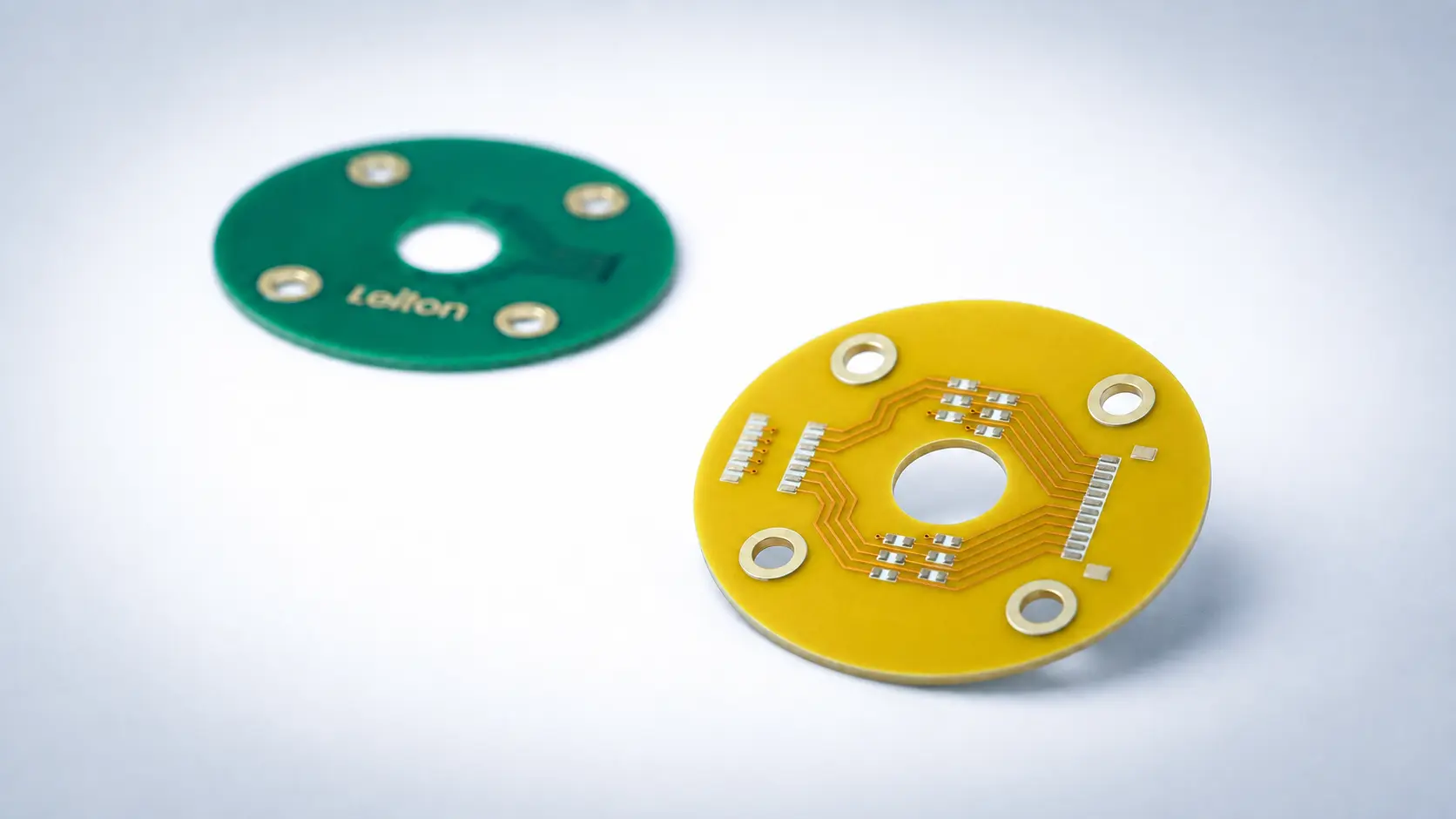
When is a coverlay used on rigid PCBs?
If a PCB is mounted directly on a metal housing and therefore requires reliable mechanical protection against electrical arcing, coverlay is the right choice. There are mechanical stresses for which the thickness of the solder mask may not be sufficient or may pose a potential risk. In such cases, coverlay can also be a suitable solution. If the outer layer requires creditable insulation, solder mask is usually not accepted. The laminated film is the reliable solution. If stray light must be excluded, the combination with black FR4 fits. The substrate is dyed through and opaque, including the edges.
The reverse also holds: for standard assemblies without these requirements, solder mask remains the economical choice. It is finer to structure and cheaper. Standard base material is regular FR4. On request, Leiton combines the film with dyed-through black FR4, for example for light-tight assemblies.
Applications
Comparison: coverlay versus solder mask and conformal coating
The coverlay competes with standard solder mask, with pressed-on prepreg layers and with coatings applied after assembly. The matrix shows the positioning.
| Solution | Typical use | When it is the right choice |
|---|---|---|
| Coverlay on rigid FR4 (Leiton) | Outer layers exposed to abrasion or with defined insulation requirements, on request combined with dyed-through black FR4. | When the surface is subject to mechanical wear or creditable insulation is required on the outer layer. |
| Solder mask | Standard for almost all rigid PCBs, finely structured by photolithography. | When there is no abrasion or insulation requirement. Formally permitted as a coating per IPC-2221, but often not accepted as insulation. |
| Pressed-on FR4 prepreg (Leiton) | FR4 prepreg is pressed over the finished outer layer. The conductors are fully embedded in laminate and count as internal. | When a qualified insulation system with specified characteristics is required, including parallel to the laminate. Details and limits on the dedicated page: read more here. |
| Conformal coating | Coating of the fully assembled board against moisture, condensation and contamination. | When the complete assembly including components must be protected, not the bare board surface. |
| Coverlay on flexible circuits | Standard construction for flex and rigid-flex, where the film replaces solder mask anyway. | When the assembly must be flexible. On rigid boards the film is the special solution, on flex the normal case. |
Advantages
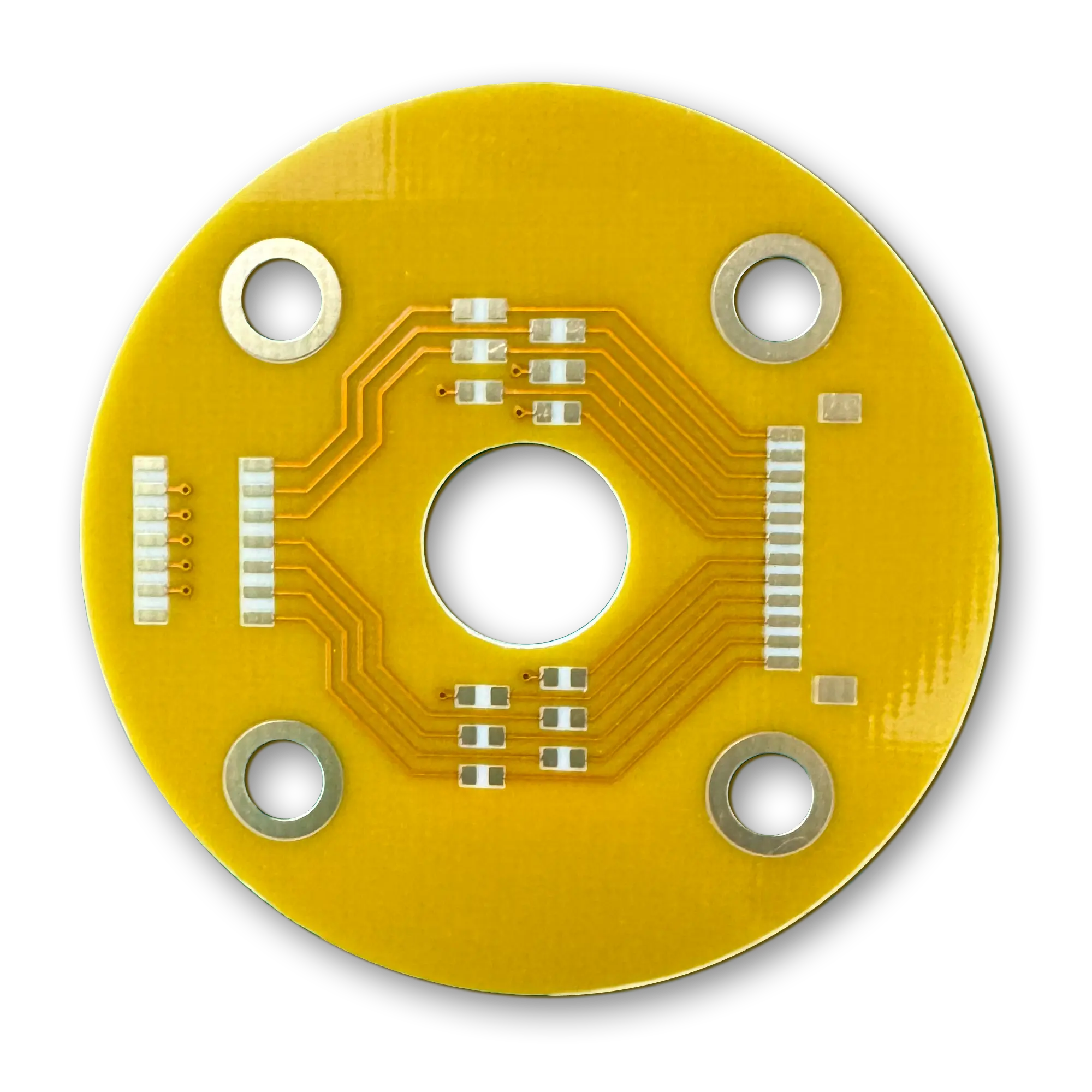
-
Abrasion resistance:
polyimide withstands continuous mechanical stress where any solder mask fails. -
Dielectric strength:
the laminated film is a defined dielectric with a data sheet value. Around 7.6 kV short-term breakdown at 25 µm polyimide. -
Normative reliability:
IPC-2221 permits reduced spacing under a permanent polymer coating (category B4). Unlike solder mask, the film has a specified thickness and dielectric strength and can be assessed as solid insulation. -
All-black construction as an option:
dyed-through black FR4 is opaque, including routed edges. -
Proven process:
Leiton applies the film successfully on rigid boards, transferred from flex production.
Important notes:
Openings in the coverlay are produced mechanically. Tolerances and minimum spacings are coarser than with photostructured solder mask. The film is only suitable to a limited extent for fine SMD structures. Lamination and mechanical processing are additional process steps and change price and lead time compared to standard solder mask. The optional black FR4 has a glass transition temperature of 130°C; check the material against high-Tg requirements. Compliance documents such as RoHS and REACH are available on request.
Option: dyed-through black FR4
On request, dyed-through black FR4 (glass-reinforced epoxy base material) serves as the base. Unlike black solder mask, the entire substrate is black, including the edges. The material is opaque, UL-listed and, with a glass transition temperature (Tg) of 130°C, comparable to standard FR4. From stock: 0.6 mm, 1.0 mm and 1.6 mm with 35 µm copper, special thicknesses are available at short notice. Details on the black FR4 page.
Dielectric strength of the coverlay
Only the polyimide film is credited. No dielectric strength is specified for the adhesive layer. It flows into the conductor pattern during lamination, so its remaining thickness over the conductors is undefined. The values apply perpendicular through the film (short-term values per ASTM D-149, Kapton HN data sheet).
| Construction | Dielectric strength of the film (data sheet) | Calculated short-term breakdown |
|---|---|---|
| 25 µm polyimide + 25 µm adhesive | 303 kV/mm (7,700 V/mil) | approx. 7.6 kV, film only |
| 50 µm polyimide + adhesive | 240 kV/mm (6,100 V/mil) | approx. 12.0 kV, film only |
These are short-term laboratory values, not permissible operating voltages. Design for continuous operation is project-specific, with significant derating for aging, moisture and partial discharge. The value does not apply parallel to the surface. For rigid base materials, dielectric breakdown parallel to laminations is tested separately (IPC-TM-650 2.5.6, reported in kV at a defined electrode spacing). No such value exists for the film itself. Between adjacent conductors under the film, the adhesive-filled gap insulates; conductor spacing per IPC-2221 remains decisive.
Request a quote
What we need for a reliable quotation: layout data (ODB++, Extended Gerber, KiCAD or similar), the areas to be covered and the open areas, the required insulation or voltage specification, material thickness and copper build-up, quantity and schedule.
Leiton places projects where they fit best in terms of price, lead time and technology. Depending on the project, coverlay PCBs are manufactured in Germany or in Asia.
Why Leiton: engineering advice on the choice between film and solder mask, coverlay experience transferred from flex production to rigid boards, black FR4 as an option from stock in three standard thicknesses, prototype to series, personal contact instead of a ticket system.
And Leiton is probably the only supplier in the world to have this technology UL certified. This enables our customers to sell their products in the USA as well.
For two reasons. Solder mask is often not accepted as insulation, because coating thickness and freedom from pinholes are not specified. A laminated polyimide film provides a defined dielectric strength. Second, the film withstands mechanical abrasion that no solder mask survives permanently.
Solder mask is applied and structured photolithographically. The coverlay is a polyimide film with adhesive, laminated under pressure and temperature. Openings are produced mechanically by drilling, routing or laser cutting and are therefore coarser. Often the film covers the full area without openings.
Only the polyimide film is credited, not the adhesive. At 25 µm polyimide, the short-term breakdown per data sheet is around 7.6 kV, at 50 µm around 12 kV. The values apply perpendicular through the film. The permissible operating voltage is designed project-specifically and is considerably lower.
Yes. The black substrate is dyed through and therefore opaque, including the edges. Black solder mask only colors the surface. Otherwise the properties correspond to standard FR4 with UL listing and Tg 130°C. Stock thicknesses are 0.6 mm, 1.0 mm and 1.6 mm with 35 µm copper.
Whenever neither abrasion nor creditable insulation is required on the outer layer. That is the normal case. Solder mask is finer to structure, faster and cheaper. The coverlay remains a targeted special solution for defined requirements.
Film material and covered area, the lamination step, mechanical processing of the openings, panel format and quantity. Add one-time setup costs (NRE, Non-Recurring Engineering). Full-area coverage without openings reduces processing effort. Reliable prices result from the layout data.
Leiton uses ENIG (Electroless Nickel Immersion Gold) in the open areas. The finish is compatible with the lamination process.
Only to a limited extent. Openings are produced mechanically and are coarser than photostructured solder mask. For fine-pitch assembly, solder mask remains the right choice. In practice, the film therefore often covers the full area or only defined partial areas.
Common names are coverlay, cover film, covercoat and polyimide overlay. Not meant are peelable masks or protective transport films, nor conformal coating on assembled boards.
Yes. Leiton is probably the only manufacturer in the world that can offer this technology with UL certification. We have a number of customers who also sell their products in the USA and therefore require the UL label.

Elektronik-Design
- Expertise through active exchange
- Expertise through training and further education

- ISO 9001:2015 Quality Management
- ISO 14001:2015 Environmental Management

- UL for rigid FR4 PCBs
- UL for flexible circuit boards
- UL for aluminum IMS boards


